

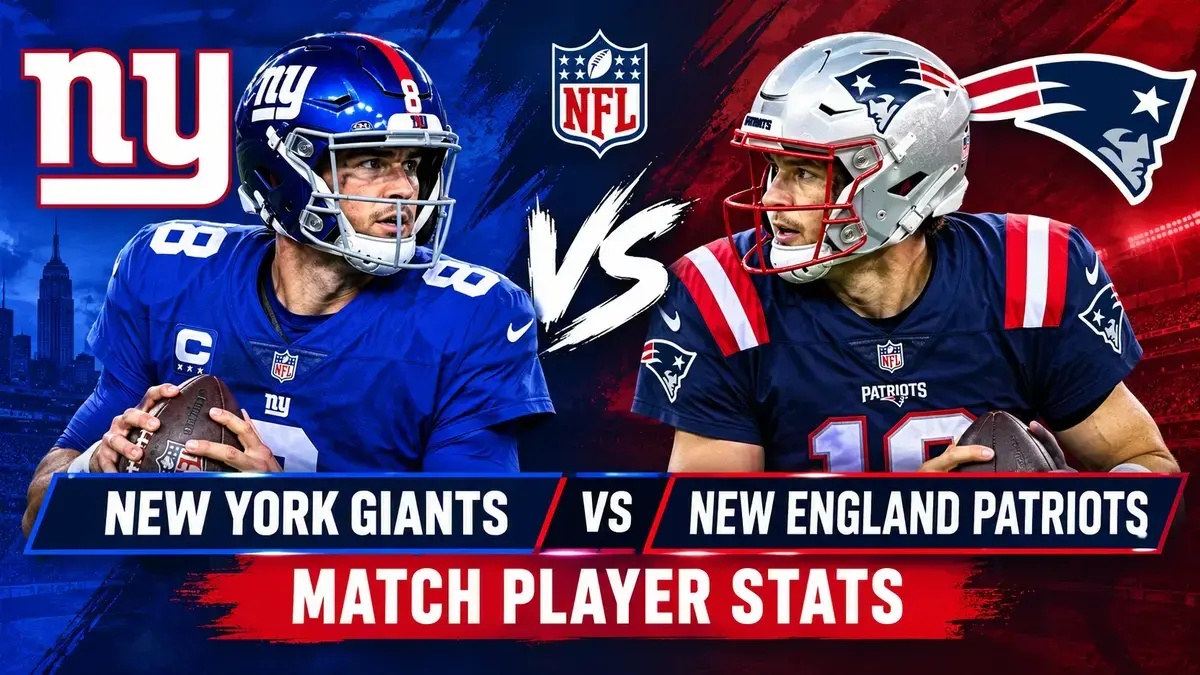
You want clean, reliable numbers from the latest Giants-Patriots game, but every site gives you a different version of the box score. Scattered stats, missing context, and confusing layouts waste your time and leave you guessing. This guide pulls every new york giants vs new england patriots match player stats into one clear, easy-to-read breakdown so you get the full picture in minutes.
A Quick Look at the Rivalry
The Giants and Patriots share one of the most famous rivalries in NFL history. These two franchises met in two Super Bowls — XLII and XLVI — and both times New York walked away with the Lombardi Trophy. Those games defined an era and gave fans memories that still spark heated debates at tailgates and dinner tables.
In the regular season, the two teams meet less often because they play in different conferences. The AFC East and NFC East rotation puts them on the same field roughly every four years. That scarcity makes every single matchup feel bigger than a typical divisional game.
When you dig into the all-time head-to-head record, the Patriots hold a slight edge in regular-season wins. But the Giants own the moments that matter most — those two Super Bowl victories over Tom Brady’s dynasty. You can explore the full all-time series history on NFL.com for a deeper dive into every game they have played.
Any time these teams meet, fans immediately search for new york giants vs new england patriots match player stats to see who showed up and who disappeared. The rivalry carries weight no matter the season or the standings.
The Most Recent Matchup: December 2, 2025 Narrative Summary
The December 2, 2025 game carried real stakes for both teams. The Patriots entered the contest fighting for AFC Wild Card positioning, while the Giants needed a win to keep their fading NFC playoff hopes alive. Cold weather and a loud crowd set the tone from the opening kickoff.
New England jumped out to an early lead behind a balanced offensive attack. The Giants answered in the second quarter with a long touchdown drive that quieted the home crowd for a moment. But the Patriots responded every time New York made a push, and the final score read 24-17 in favor of New England.
Turnovers, a controversial fourth-down call, and a late interception sealed the outcome. Anyone tracking new york giants vs new england patriots match player stats from this game will notice how a few individual performances swung the entire result.
The atmosphere felt like a playoff game even though the calendar still said December. Both fan bases traveled well, and the stadium noise made communication difficult for both quarterbacks at different points in the game.
Team Totals and Efficiency Comparison
Raw team totals tell the first part of the story. New England controlled the clock and won the turnover battle, which almost always decides close games. The Giants moved the ball in bursts but could not sustain long drives consistently.
| Stat Category | New York Giants | New England Patriots |
|---|---|---|
| Total Yards | 312 | 378 |
| Passing Yards | 214 | 267 |
| Rushing Yards | 98 | 111 |
| First Downs | 17 | 22 |
| Third-Down Conversions | 4/13 (31%) | 7/15 (47%) |
| Red-Zone Trips | 3 | 4 |
| Red-Zone TDs | 2 | 3 |
| Turnovers | 2 | 1 |
| Time of Possession | 26:14 | 33:46 |
| Penalties (Yards) | 6 (48) | 4 (30) |
The efficiency gap shows up clearly on third down. The Patriots converted nearly half their third-down attempts, which kept the Giants’ defense on the field and wore them down by the fourth quarter. New York’s 31% conversion rate killed drives that should have produced points.
When you review new york giants vs new england patriots match player stats at the team level, the turnover margin jumps out as the biggest difference-maker. Two giveaways from the Giants directly led to 10 Patriots points.
Complete Quarterback Matchup and Passing Stats
Drake Maye played with poise beyond his years, while Daniel Jones struggled under pressure and made two critical mistakes that cost his team dearly.
| Passing Stat | Daniel Jones (NYG) | Drake Maye (NE) |
|---|---|---|
| Completions/Attempts | 19/31 | 22/34 |
| Completion % | 61.3% | 64.7% |
| Passing Yards | 214 | 267 |
| Touchdowns | 1 | 2 |
| Interceptions | 2 | 1 |
| Longest Completion | 38 yards | 44 yards |
| Sacks Taken | 3 | 1 |
| Passer Rating | 65.8 | 95.6 |
| Yards Per Attempt | 6.9 | 7.9 |
Maye spread the ball around effectively and took what the Giants’ defense gave him. His 44-yard completion in the third quarter set up a go-ahead touchdown and shifted momentum firmly in New England’s favor. He avoided forcing throws into tight windows for the most part.
Jones started sharp and hit Malik Nabers on a beautiful 38-yard strike in the first quarter. But pressure from the Patriots’ edge rushers rattled him as the game wore on. His second interception — a forced throw into double coverage in the red zone — effectively ended the Giants’ comeback chances.
Fans who pull up new york giants vs new england patriots match player stats for this game will see the passer rating gap tells the whole story. A 30-point difference in rating between the two quarterbacks is almost impossible to overcome in a one-score game.
Rushing Leaders and Ground Game Performance
Both teams committed to the run, but the Patriots got more out of their ground attack. Rhamondre Stevenson punished the Giants’ front seven with consistent production between the tackles and broke a few long runs that kept drives alive.
| Rushing Stat | Player | Team | Carries | Yards | Avg | TD | Long |
|---|---|---|---|---|---|---|---|
| RB1 | Rhamondre Stevenson | NE | 18 | 94 | 5.2 | 1 | 22 |
| RB2 | Tyrone Tracy Jr. | NYG | 14 | 67 | 4.8 | 1 | 18 |
| RB3 | Antonio Gibson | NE | 7 | 17 | 2.4 | 0 | 6 |
| QB | Daniel Jones | NYG | 3 | 18 | 6.0 | 0 | 12 |
| QB | Drake Maye | NE | 4 | 13 | 3.3 | 0 | 8 |
Stevenson’s 22-yard run in the second quarter set up New England’s first touchdown of the game. He consistently fell forward after contact and forced the Giants to commit an extra defender to the box, which opened up play-action opportunities for Maye.
Tracy gave the Giants solid work and scored on a tough 4-yard run in the second quarter. But New York abandoned the run too early in the second half when they fell behind. Only five carries after halftime limited their ability to control tempo.
The rushing numbers in any new york giants vs new england patriots match player stats breakdown reveal how much the ground game affects play-calling. New England’s 111 rushing yards kept the Giants’ defense honest and created the spacing Maye needed to throw effectively.
Receiving Production and Target Breakdown
Malik Nabers led all receivers in catches and yards, but the Patriots distributed their targets more evenly across multiple players. That balanced attack made it harder for the Giants’ secondary to key on any single route runner.
| Receiving Stat | Player | Team | Targets | Catches | Yards | Avg | TD | Long |
|---|---|---|---|---|---|---|---|---|
| WR1 | Malik Nabers | NYG | 10 | 7 | 89 | 12.7 | 0 | 38 |
| WR2 | Kayshon Boutte | NE | 7 | 5 | 72 | 14.4 | 1 | 44 |
| TE | Hunter Henry | NE | 6 | 5 | 58 | 11.6 | 1 | 19 |
| WR3 | Darius Slayton | NYG | 6 | 4 | 51 | 12.8 | 0 | 21 |
| WR4 | DeMario Douglas | NE | 5 | 4 | 48 | 12.0 | 0 | 16 |
| RB | Rhamondre Stevenson | NE | 4 | 4 | 35 | 8.8 | 0 | 14 |
| TE | Daniel Bellinger | NYG | 4 | 3 | 28 | 9.3 | 1 | 14 |
| WR5 | Wan’Dale Robinson | NYG | 5 | 3 | 22 | 7.3 | 0 | 11 |
Nabers drew 10 targets and made the most of them, but the Giants could not get him the ball in the red zone. His 89 yards came largely between the 20-yard lines. The Patriots’ cornerbacks, especially Christian Gonzalez, did a strong job limiting Nabers near the goal line.
Boutte’s 44-yard catch-and-run in the third quarter was the play of the game. He caught a quick slant, broke a tackle, and outran the safety to the Patriots’ 6-yard line. Henry caught the touchdown two plays later on a seam route that split the Giants’ linebackers.
New England spread 26 targets across six players. New York funneled 25 targets to just four, which made them easier to defend in the second half.
Defensive Plays, Turnovers, and Sacks
The Patriots’ defense made the plays that mattered most. Brian Burns generated consistent pressure off the edge, and the secondary capitalized on Jones’s forced throws to create two turnovers that changed the scoreboard.
| Defensive Stat | Player | Team | Tackles | Sacks | TFL | INT | FF | PD |
|---|---|---|---|---|---|---|---|---|
| EDGE | Brian Burns | NYG | 5 | 1.0 | 2 | 0 | 0 | 1 |
| DT | Dexter Lawrence | NYG | 4 | 0.5 | 1 | 0 | 0 | 0 |
| LB | Bobby Okereke | NYG | 9 | 0 | 1 | 0 | 0 | 2 |
| CB | Christian Gonzalez | NE | 4 | 0 | 0 | 1 | 0 | 3 |
| EDGE | Keion White | NE | 3 | 1.5 | 2 | 0 | 1 | 0 |
| LB | Ja’Whaun Bentley | NE | 8 | 0 | 1 | 0 | 0 | 1 |
| S | Kyle Dugger | NE | 6 | 0 | 0 | 1 | 0 | 2 |
| S | Jason Pinnock | NYG | 7 | 0 | 0 | 0 | 0 | 1 |
Gonzalez played a near-perfect game in coverage. He shadowed Nabers for most of the second half and held him to just two catches after halftime. His three pass deflections came in critical situations, including a third-down breakup that forced a Giants punt in the fourth quarter.
Dugger’s interception in the red zone was the back-breaker for New York. Jones tried to squeeze a pass into a tight window on second-and-goal from the 8-yard line. Dugger read the route, jumped the throw, and returned it to the 25-yard line to flip field position completely.
Burns and Lawrence combined for 1.5 sacks and constant disruption up the middle, but the Giants’ pass rush could not generate enough pressure to rattle Maye consistently. The Patriots’ offensive line gave their young quarterback a clean pocket on most dropbacks.
Anyone reviewing new york giants vs new england patriots match player stats on the defensive side should focus on the turnover column. The Patriots’ two takeaways led directly to 10 points, while the Giants’ single takeaway produced zero points on the ensuing drive.
Step-by-Step Game-Changing Moments
This matchup featured four distinct moments that swung the scoreboard and the energy inside the stadium.
First Quarter, 8:12 — Nabers’ 38-Yard Catch. Jones launched a deep ball down the right sideline, and Nabers hauled it in over Gonzalez for a 38-yard gain to the Patriots’ 14-yard line. The Giants scored three plays later on a Bellinger touchdown catch. Giants lead 7-0.
Second Quarter, 3:45 — Stevenson’s 22-Yard Run. Stevenson bounced a run outside, broke a tackle from Okereke, and raced 22 yards to the Giants’ 11-yard line. Maye hit Henry for a touchdown two plays later to tie the game at 10-10 heading into halftime.
Third Quarter, 6:22 — Boutte’s 44-Yard Catch-and-Run. Maye fired a quick slant to Boutte, who caught it at the line of scrimmage, spun away from Pinnock, and sprinted 44 yards to the Giants’ 6-yard line. Henry scored on the next play. Patriots lead 17-10.
Fourth Quarter, 9:05 — Dugger’s Red-Zone Interception. Dugger undercut the route, picked the ball off, and returned it to the 25. The Patriots kicked a field goal on the next drive to extend their lead to 24-17.
These four plays account for the entire scoring margin. When you look at new york giants vs new england patriots match player stats chronologically, you can see how individual moments — not overall yardage — decided the outcome.
What the Numbers Tell Us About Each Team
The box score reveals clear strengths and weaknesses for both rosters that will carry forward into the rest of the season.
New England’s offense is maturing fast. Maye’s 95.6 passer rating against a solid Giants secondary shows real growth. The Patriots’ balanced attack — 267 passing yards and 111 rushing yards — makes them difficult to game-plan against. Their offensive line allowed only one sack, which gives their young quarterback the time he needs to progress through reads.
New York’s defense played well enough to win. Burns and Lawrence created pressure, and Okereke flew around the field with nine tackles. The problem was the offense. Two interceptions and a 31% third-down conversion rate put the defense in impossible situations all afternoon.
The Giants’ passing game lacks depth. Nabers is a legitimate WR1, but the drop-off after him is steep. Slayton and Robinson combined for 73 yards on seven catches. Opposing defenses will continue to double Nabers until another receiver forces them to adjust.
New England’s secondary is the real deal. Gonzalez, Dugger, and the rest of the defensive backfield held the Giants to 214 passing yards and created two turnovers. That unit has the talent to compete with any receiving corps in the league.
Breaking down new york giants vs new england patriots match player stats position by position shows that the Patriots won the game in the trenches and in the secondary. The Giants need more consistent quarterback play and a deeper receiving room to compete in close games like this one.
Looking Back: How the Rivalry Has Unfolded Over Time
The Giants-Patriots rivalry stretches back decades, but two games define it for most fans. Super Bowl XLII in 2008 remains one of the greatest upsets in sports history. Eli Manning’s helmet catch to David Tyree and the Giants’ 17-14 victory over the previously undefeated Patriots shocked the world.
Four years later, the two teams met again in Super Bowl XLVI. Manning engineered another late-game drive, and the Giants won 21-17 to spoil New England’s bid for a fourth championship. Those two Super Bowl wins give the Giants a permanent edge in the rivalry’s biggest moments.
In regular-season play, the Patriots have dominated more often. Tom Brady carved up the Giants’ defense in several memorable matchups during the 2000s and 2010s. The 2011 regular-season game where the Patriots won 27-20 in New York stands out as one of the better regular-season meetings.
You can browse the complete historical box scores and head-to-head records on Pro Football Reference for every game these two franchises have played since their first meeting.
The star matchups have evolved over time. Phil Simms vs. Steve Grogan gave way to Eli Manning vs. Tom Brady, and now a new generation takes the field.
Historical new york giants vs new england patriots match player stats show a pattern of close, hard-fought games decided by a handful of plays. That tradition held true in December 2025.
Why Player Stats Matter in This Matchup
Numbers without context mean nothing. A quarterback can throw for 300 yards and still lose if he throws two interceptions in the red zone. A running back can average six yards per carry and still watch his team lose if the defense cannot get off the field on third down.
Player stats matter because they reveal the why behind the final score. The Patriots won this game because Maye protected the football, Stevenson controlled the clock, and Gonzalez shut down the Giants’ best receiver in the second half. Those individual performances add up to a team victory.
For fans, understanding new york giants vs new england patriots match player stats helps you argue your case with friends, make better fantasy football decisions, and appreciate the chess match that coaches play every Sunday. Stats turn casual viewing into informed fandom.
For bettors and analysts, these numbers expose trends that carry forward. The Giants’ red-zone struggles and the Patriots’ third-down efficiency are not one-game flukes. They reflect real schematic strengths and weaknesses that will show up again in future matchups.
You can find advanced analytics and deeper breakdowns of these stats on ESPN for additional perspective on how each player performed relative to league averages.
Final Thoughts and Fan Community Takeaways
The Patriots earned this win with balanced offense, timely defense, and smart football in critical moments. The Giants showed flashes of brilliance — Nabers is the real deal, and Burns remains one of the most disruptive edge rushers in the league — but turnovers and third-down failures cost them a game they could have won.
If you follow the Giants, the takeaway is clear. The offense needs more weapons around Nabers, and Jones has to protect the football better in high-leverage situations. The defense played well enough to win, and that should give fans hope moving forward.
If you root for the Patriots, this game confirms that the rebuild is ahead of schedule. Maye looks like a franchise quarterback, the defense creates turnovers, and the coaching staff puts players in positions to succeed.
Bookmark this page the next time you need a complete new york giants vs new england patriots match player stats breakdown. We update our coverage after every meeting between these two historic franchises so you always have one reliable source for every number that matters.
Share your thoughts in the comments. Which stat surprised you the most? Do you think the Giants can bounce back in the rematch? Let the debate begin.