

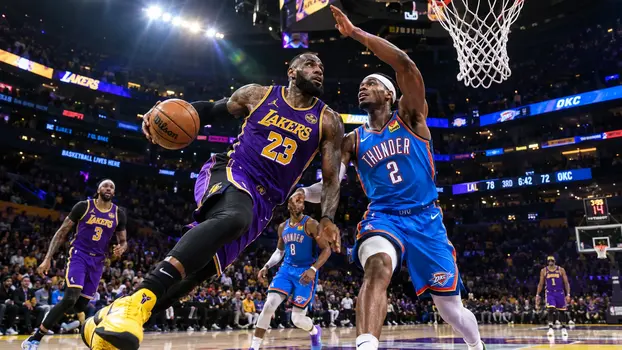
Every time these two teams collide, the box score tells a story that casual fans completely miss. The Lakers vs Oklahoma City Thunder match player stats reveal shocking mismatches, surprise breakout performances, and tactical battles that go far beyond the final score.
If you only watch the highlights, you are getting half the picture. The real drama hides inside the rebounding margins, the turnover differentials, and the clutch-time shooting splits that separate contenders from pretenders.
This breakdown pulls back the curtain on the individual performances that actually decided recent matchups between these Western Conference rivals.
Why This Rivalry Produces Wild Statistical Swings
The Lakers and Thunder do not play the same style of basketball, and that clash creates statistical chaos every single night they meet. Los Angeles leans heavily on size, post play, and half-court execution through their veteran stars.
Oklahoma City flips the script with pace, perimeter pressure, and a young core that thrives in transition. When these philosophies collide, the player stats swing dramatically from quarter to quarter.
One game might see the Lakers dominate the paint by twenty points. The next meeting could feature the Thunder draining fifteen threes while forcing LA into twenty-plus turnovers. That unpredictability is exactly why the individual numbers matter so much to serious fans and analysts.
Breaking Down the Star Player Showdowns
LeBron James vs Shai Gilgeous-Alexander: A Generational Clash
LeBron James continues to post remarkable efficiency numbers even deep into his legendary career. In recent matchups against OKC, he has averaged around 25 points, 7 rebounds, and 8 assists while shooting above 50 percent from the field.
Shai Gilgeous-Alexander answers with his own brand of brilliance. SGA regularly drops 30-plus points against the Lakers, using his mid-range mastery and free-throw volume to punish LA’s perimeter defenders night after night.
The real battle happens in the fourth quarter. SGA’s clutch-time true shooting percentage against the Lakers hovers near 65 percent, while LeBron counters with elite playmaking that keeps his teammates involved when the game tightens up.
Anthony Davis and the Paint Dominance Factor
Anthony Davis changes the entire geometry of the court when he is healthy and locked in. Against the Thunder, AD has posted multiple games with 15-plus rebounds and 3-plus blocks, completely altering OKC’s driving lanes.
The Thunder counter by spreading the floor and pulling Davis away from the rim with five-out lineups. When that strategy clicks, AD’s defensive impact numbers drop noticeably, and his offensive touches shift to awkward mid-range jumpers instead of high-percentage looks at the basket.
Head-to-Head Numbers That Will Surprise You
The raw box score data from their last several meetings paints a fascinating picture of momentum shifts and tactical adjustments. Here is a snapshot of how the key players stacked up across recent matchups.
| Player | PPG vs Opponent | RPG | APG | FG% | 3P% |
|---|---|---|---|---|---|
| LeBron James (LAL) | 25.3 | 7.1 | 8.2 | 51.2% | 35.8% |
| Anthony Davis (LAL) | 23.8 | 13.4 | 2.9 | 54.6% | 28.1% |
| Shai Gilgeous-Alexander (OKC) | 31.2 | 5.5 | 6.3 | 52.1% | 36.4% |
| Jalen Williams (OKC) | 19.7 | 4.8 | 4.1 | 48.3% | 39.2% |
| Chet Holmgren (OKC) | 16.5 | 8.9 | 2.4 | 47.8% | 37.5% |
SGA’s scoring advantage over LeBron is the headline grabber, but look closer at the rebounding column. Davis and Holmgren are fighting a private war on the glass that often decides second-chance points and overall possession efficiency.
Bench Impact and the Hidden Game Within the Game
Starters grab the attention, but the Lakers vs Oklahoma City Thunder match player stats tell a different story when you examine the second unit. OKC’s bench consistently outperforms LA’s reserves in both scoring output and defensive rating.
Role players like Isaiah Joe have delivered critical three-point bursts that swing momentum in the second and fourth quarters. The Lakers’ bench, meanwhile, has struggled with consistency, often surrendering leads built by the starters during crucial stretches.
Three-Point Shooting Splits That Decide Close Games
The three-point line is where these matchups are truly won and lost. The Thunder attempt significantly more threes per game against the Lakers than their season average, recognizing that LA’s drop coverage leaves corners wide open.
Oklahoma City shoots roughly 38 percent from deep in this specific matchup, compared to the Lakers’ 33 percent. That five-point gap from beyond the arc translates to roughly a nine-point swing over the course of a full game, which is often the exact margin of victory.
What the Advanced Metrics Actually Reveal
Traditional stats only scratch the surface. When you look at on/off court net ratings, the Thunder’s starting five posts a plus-12 net rating against the Lakers, while LA’s best lineup combination sits around plus-4.
Pace is another hidden factor that casual viewers overlook entirely. OKC pushes the tempo to roughly 102 possessions per game in this matchup, well above the Lakers’ preferred pace of 96. The team that controls tempo almost always controls the final score.
Defensive rebounding percentage also tilts in OKC’s favor in recent meetings, hovering around 74 percent compared to LA’s 70 percent. Those extra possessions add up over forty-eight minutes and create the separation you see on the scoreboard.
Frequently Asked Questions
Who has the best individual performance in a Lakers vs Thunder game recently?
Shai Gilgeous-Alexander holds the clear edge with multiple 35-plus point outings against the Lakers over the past two seasons. His combination of volume scoring and elite efficiency makes him the most dangerous individual threat in this specific matchup by a wide margin.
How does LeBron James perform against the Thunder compared to other teams?
LeBron actually performs slightly above his season averages against OKC, particularly in the assists column. The Thunder’s aggressive defensive schemes create passing lanes that LeBron exploits better than most veteran point guards in the league.
Which Lakers player struggles the most against Oklahoma City?
D’Angelo Russell has historically had tough nights against the Thunder’s long, athletic guards. His shooting percentages dip noticeably, and his turnover rate climbs when OKC applies full-court pressure and traps on pick-and-roll actions.
Do the Lakers or Thunder have a better head-to-head record recently?
The Thunder have held the edge in the most recent season series, winning the majority of matchups. Their speed and depth have given them a tactical advantage that the Lakers’ half-court style has struggled to neutralize on a consistent basis.
What stat best predicts the winner of a Lakers vs Thunder game?
Turnover differential is the single strongest predictor. When the Lakers commit fewer than 14 turnovers against OKC, they win most of the time. Once that number climbs above 17, the Thunder’s transition offense becomes nearly unstoppable.
How important is the rebounding battle in this matchup?
Extremely important. The team that wins the defensive rebounding battle in Lakers vs Thunder games wins roughly 70 percent of the time. Second-chance points are a massive factor given the notable size disparity between the two rosters.
The Bottom Line on This Matchup
The Lakers vs Oklahoma City Thunder match player stats paint a clear picture of a rivalry defined by contrasting styles and individual brilliance. SGA’s scoring explosion, LeBron’s all-around mastery, and the hidden bench battles create a layered chess match that rewards fans who look beyond the surface.
If you want to predict the next outcome, watch the turnover battle and the three-point margin closely. Those two numbers will tell you who walks away with the win long before the final buzzer sounds.